NuajProtect

DDoS protection · Now in beta

Attacks never reach
you.

Stopped at your edge — on a NuajBridge, your Linux servers or your MikroTik routers.

Free during the beta.

It begins

An attack begins.
You see it at once.

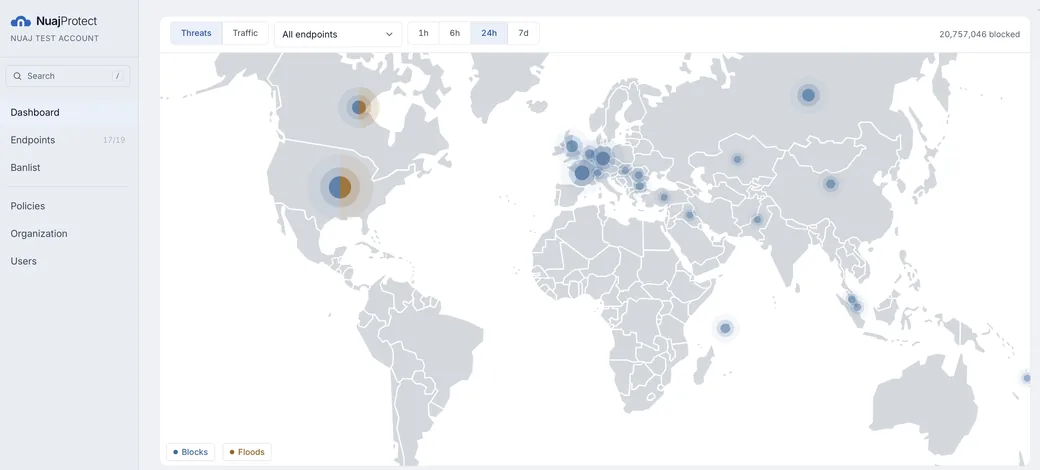
Every edge you protect reports to one live map.
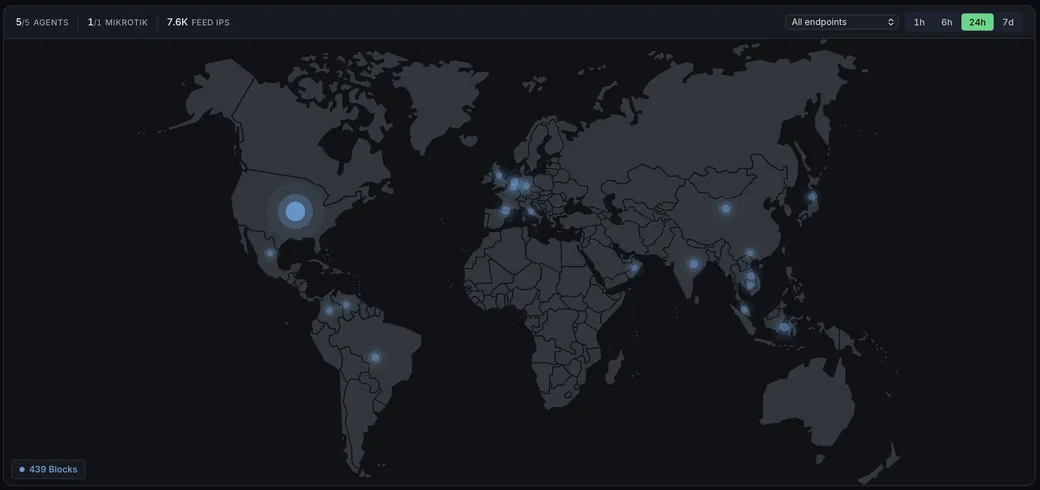
The NuajProtect dashboard: a live world map of blocked attacks and floods across every protected endpoint The NuajProtect dashboard: a live world map of blocked attacks and floods across every protected endpoint

It is stopped

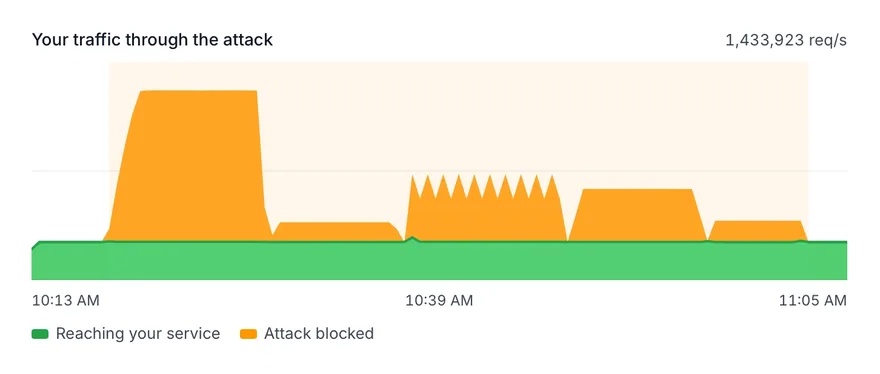
Five waves.
Your traffic never noticed.

Forty-five minutes of attack, stopped at the edge. Everything you serve ran flat beneath it.
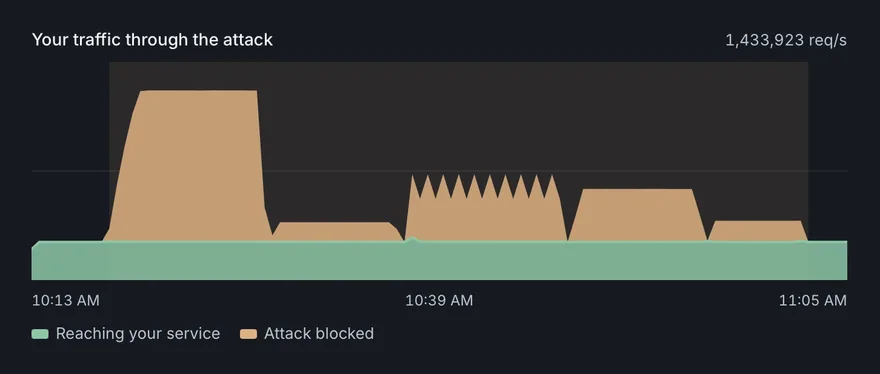
Your traffic through a 45-minute attack: five waves of attack traffic blocked, and the traffic reaching your service flat throughout Your traffic through a 45-minute attack: five waves of attack traffic blocked, and the traffic reaching your service flat throughout

It is explained

Then the whole story.
In one report.

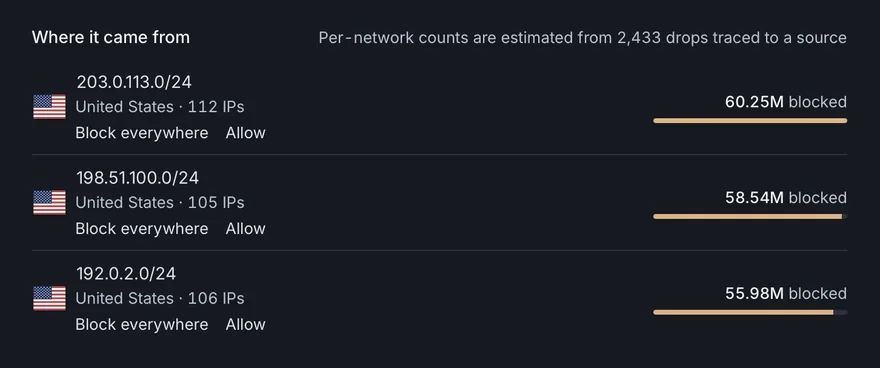
How long it lasted, what was blocked, and every network it came from.

45min

Duration

1.04billion

Blocked

2,000

Sources

215

Networks

Where the attack came from: each source network with its country, its address count and how much of the attack it sent, with Block everywhere and Allow beside it Where the attack came from: each source network with its country, its address count and how much of the attack it sent, with Block everywhere and Allow beside it

A 45-minute test attack on the NuajProtect bench, October 2026.

You decide

Your call.
On every edge at once.

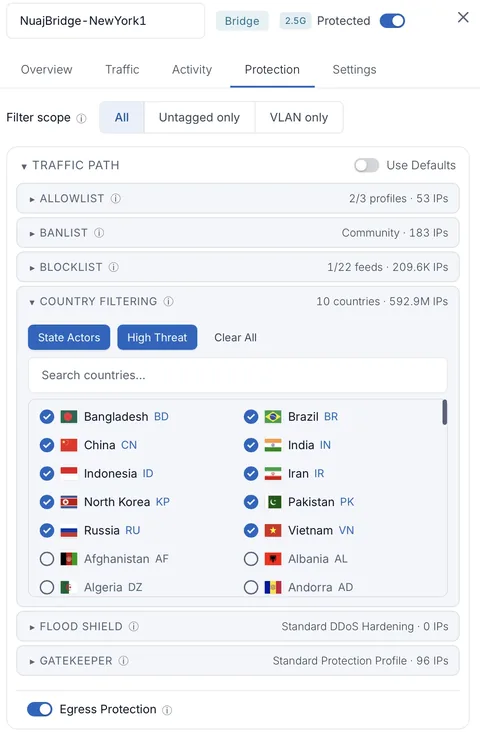
Block a network everywhere with one click. Choose the feeds and countries each edge enforces.
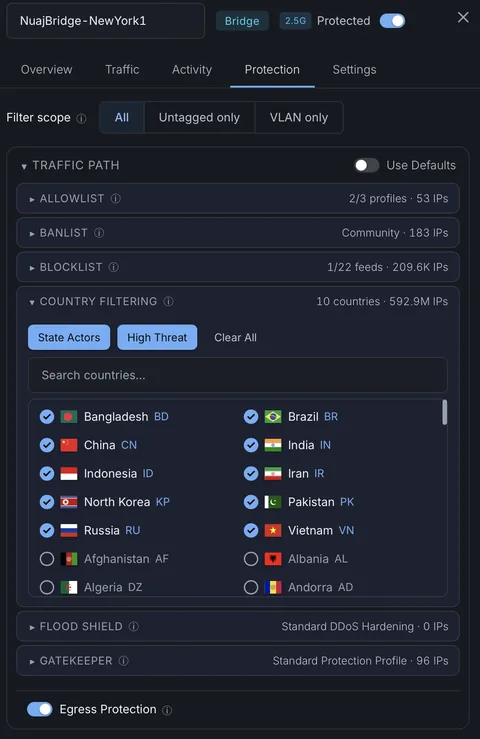
Protection settings for a NuajBridge: allowlist, banlist, blocklist feeds and country filtering Protection settings for a NuajBridge: allowlist, banlist, blocklist feeds and country filtering
Your rules, per edge or everywhere.
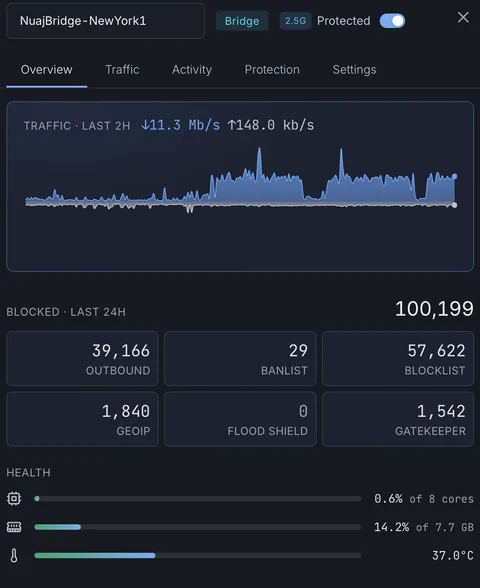
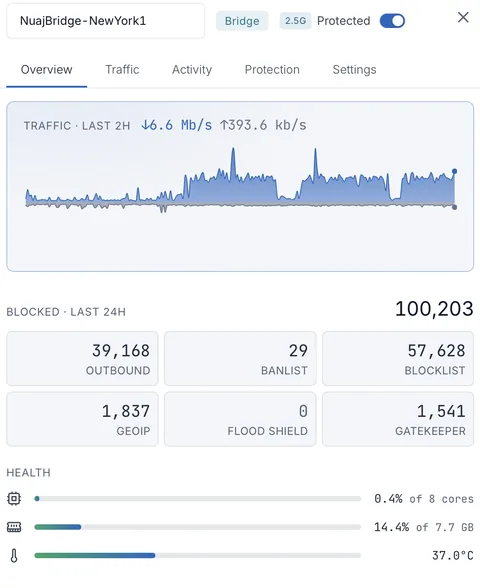
A NuajBridge at a glance: its traffic over two hours, what it blocked in the last day by reason, and its health A NuajBridge at a glance: its traffic over two hours, what it blocked in the last day by reason, and its health
Every edge at a glance.

How it works

Every connection.
Checked before it lands.

What one edge learns, every edge enforces.

1

Known threats, blocked

Live threat feeds and your own list stop botnets and scanners.

2

New attacks, caught

A source turns hostile. Every edge blocks it.

3

DDoS, absorbed

Floods are shed at the edge, judged against your normal.

4

Regions, controlled

Choose which countries reach which services.

5

Probing, stopped

Scans and brute force give a source away.

6

Trusted, untouched

The people and systems you trust pass untouched.

Where it runs

Three ways to run it.
One account.

A NuajBridge in front of a whole network, or the servers and routers you already run.

Appliance · Coming soon

NuajBridge

Between your internet connection and your router. Nothing to install, nothing to attack.

  • 2.5G and 25G models
  • Every packet, in and out
  • 99.8% of your traffic delivered during an attack
Learn more about NuajBridge

On your servers

Linux

One binary on the server. Hostile traffic stops before it reaches your website, mail or DNS.

  • Web servers, APIs and reverse proxies
  • Mail, DNS, VPN and game servers
  • Or in front of them, as a relay
  • Your applications can report attackers
Learn more about NuajProtect on Linux

On your routers

MikroTik

One generated script, pasted into the router’s terminal. Its own firewall does the enforcing.

  • RouterOS 7.13 or later
  • IPv4 and IPv6
  • Enforced by RouterOS’ own firewall
Learn more about NuajProtect on MikroTik

Each one sits in front of what it protects, behind it, or invisibly in the path. See which goes where

How it fits together

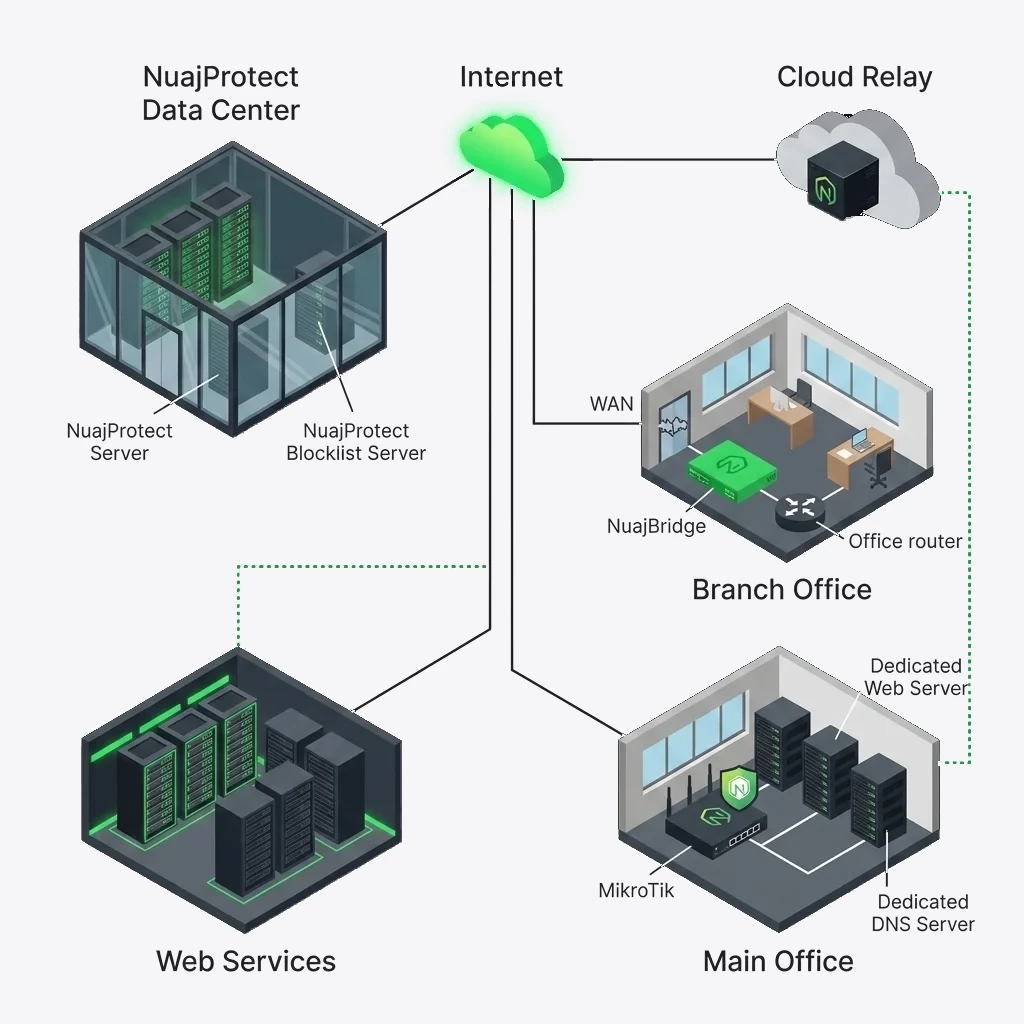
Servers, routers, remote services and whole network edges, protected from one central policy.
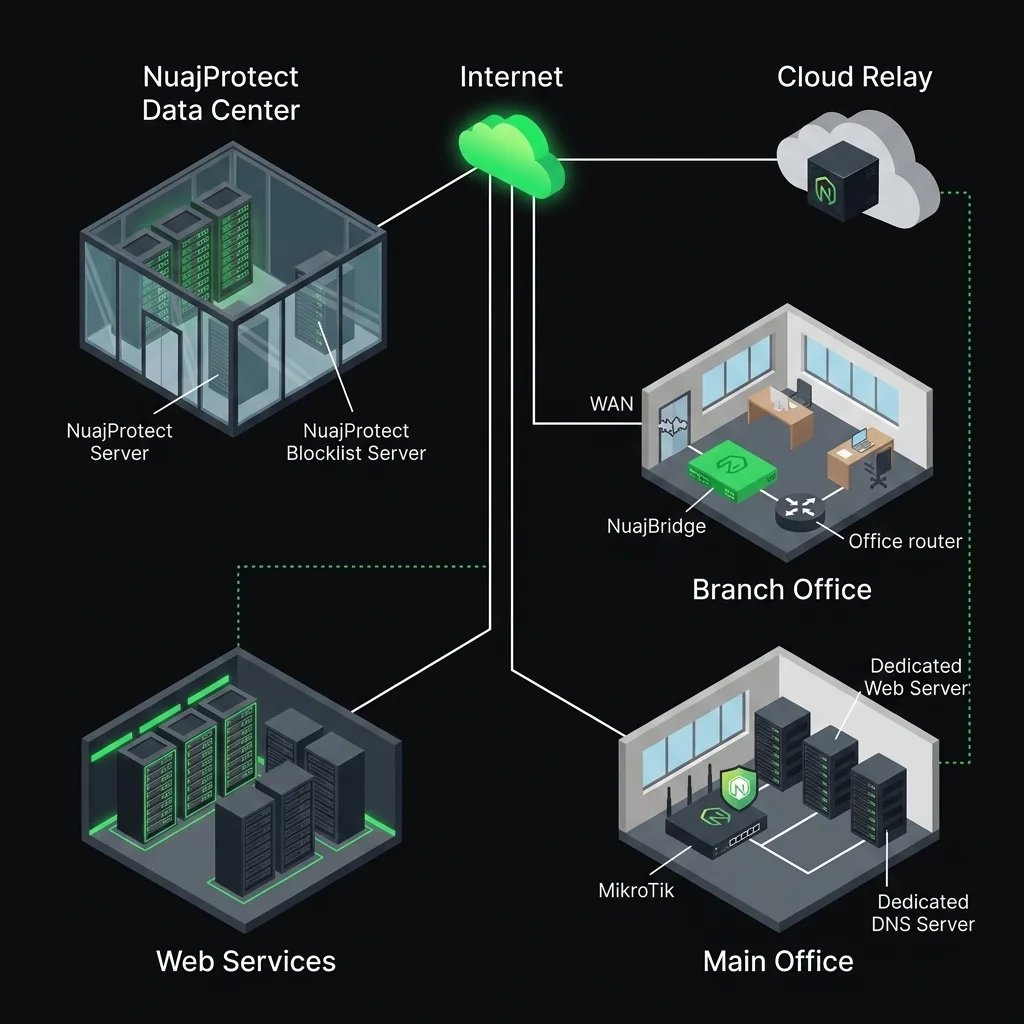
How NuajProtect is deployed: the global threat-intelligence network feeding NuajBridge appliances, Linux agents and MikroTik routers at each protected edge How NuajProtect is deployed: the global threat-intelligence network feeding NuajBridge appliances, Linux agents and MikroTik routers at each protected edge

Security

Shared protection.
Without shared risk.

Every location learns from every attack, and stays yours alone.

Communications

Encrypted end to end

Outbound-only and encrypted. No open port for an attacker to reach.

Authentication

Multi-factor authentication

Authenticator apps, passkeys, SMS and email. Built in, not an add-on.

Access control

Role-based permissions

Six roles, from Account User to Super Admin, for every tenant.

Notifications

Real-time alerts

Email and SMS the moment an attack starts or an edge goes quiet.

Integration

Your apps can fight back

The failed logins and scraping your apps see become blocks on every edge.

Flexibility

Policy profiles

Standard profiles, or your own per edge, site or customer.

Prefer it in-house? NuajProtect runs fully self-hosted, even air-gapped. Talk to us about self-hosting

Where it started

Built by operators.
Proven in production.

NuajProtect defends the networks of Halton Data Center, a Canadian colocation and cloud provider. Every release runs there first. Visit Halton Data Center

At a glance

NuajProtect,
at a glance.

NuajProtect is edge threat protection for servers, routers and whole networks: network security software, and a network security appliance, that removes hostile traffic before it reaches what you run — infrastructure already known to be attacking, from a live global feed, and everything nobody has classified yet, worked out on the spot. Every decision is enforced in the traffic path, with no proxy. It runs on the Linux servers you already own, on MikroTik routers, and on the NuajBridge inline appliance.

NuajProtect at a glance
Product type Edge threat protection — network security software and a network security appliance
What it does Blocks malicious inbound traffic at the network edge: known hostile sources, floods, port scanners, repeat offenders and application-reported abuse
Runs on Linux servers (single static binary under systemd, x86-64 and arm64) · MikroTik RouterOS 7.13+ · NuajBridge appliance, 2.5G and 25G, coming soon
Enforcement Accelerated filtering on Linux and NuajBridge; RouterOS firewall on MikroTik. No proxy, no extra routing hop
Placement Sentry (protects the host it runs on) · Relay (protects what is behind it, directly or over GRE, WireGuard or IPsec) · Bridge (transparent, inline, no address to attack)
Addressing IPv4 and IPv6, first-class in both
Control plane Managed SaaS, or self-hosted for data sovereignty and air-gapped networks
Availability In beta, and free to join. NuajBridge appliances are coming soon
Licence Proprietary. End User Licence Agreement
Vendor Nuaj Company Inc., Ontario, Canada

Questions

Everything you need
to know.

What is NuajProtect?
NuajProtect is edge security that blocks malicious traffic before it reaches your servers, routers and networks. It combines live global threat intelligence with detection that runs where your traffic actually arrives — floods, port scanners, repeat offenders and abuse your own applications report — and enforces the result inline, with no proxy in the path.
What platforms does NuajProtect run on?
The NuajBridge appliance protects a whole network with nothing to install. The same engine — intelligence and detection both — runs as software on your Linux servers and as generated rule chains on MikroTik routers, so every deployment is a sensor as well as an enforcement point. No re-architecting required.
How is NuajProtect different from a traditional firewall?
A firewall enforces the static rules you write, and it can only act on what those rules already describe. NuajProtect adds the part a rule can’t express. It feeds your edge a live picture of known-hostile infrastructure and removes it in the path, and it decides about traffic nobody has classified yet: floods judged against the baseline your link actually runs at rather than a fixed number, scanners that give themselves away by touching ports nothing legitimate touches, repeat offenders escalated on their own record, and application-level abuse your own software reports from inside. What one protected site works out, the others enforce. It complements your firewall — it doesn’t replace it.
Will NuajProtect slow down my network?
There is no proxy and no extra routing hop: filtering happens at the earliest point in the traffic path, so accepted traffic is forwarded rather than reassembled. What you should watch for is not throughput but a wrong call — any filter can misjudge unusual but legitimate traffic. That is what the allowlist, the per-endpoint activity view and monitor mode are for: run it watching before you run it blocking.
Is NuajProtect self-hosted or SaaS?
Both. Run it fully self-hosted for data sovereignty and air-gapped environments, or use the managed SaaS and let us operate the control plane for you.
How do I get access to NuajProtect?
NuajProtect is in beta, and free to join. NuajBridge appliances — 2.5G and 25G — are coming soon, and beta members get priority access as each model ships. Protect a server in software in minutes, reserve a NuajBridge for whole-network protection, or talk to us about a larger deployment.
How do I stop a DDoS or UDP flood at my network edge?
A flood is only a flood relative to what your link normally carries, so NuajProtect measures the baseline your connection actually runs at and judges against that rather than against a number someone typed in. When a source crosses it, the drop is enforced at the earliest possible point, before it reaches your application, and with no proxy in the path. Reflection and amplification floods are caught the same way, which matters because they are usually a small share of a big link rather than an obvious spike. Run it in monitor mode first: you watch the calls it would make against your own traffic before any of them are enforced.
Does NuajProtect filter IPv6 as well as IPv4?
Yes, and not as an afterthought. Blocklists, allowlists, detection and enforcement are dual-stack throughout, on every platform — the Linux agent, MikroTik address lists and the NuajBridge appliance. An edge that filters only IPv4 is an edge with a second, unguarded front door.
What happens if NuajProtect loses contact with the control plane?
The edge keeps enforcing what it already knows. Blocking is local — the device itself holds the lists — so a network problem between you and us costs you updates, not protection. On the Linux agent you can still see and change what is being enforced through a console bound to the loopback address, which is also the way back in if a rule ever locks you out.
How is NuajProtect different from Fail2ban or CrowdSec?
Fail2ban bans an address after it fails on one server, reading that server’s own logs. NuajProtect blocks known-hostile sources from live threat feeds before they connect, detects floods, port scans and brute-force attempts where your traffic arrives, and enforces what one edge learns on every edge you run, from one dashboard. Like CrowdSec it learns from a community, and you choose who you share with and how many separate devices must report an attacker first.
Is NuajProtect a cloud DDoS protection service?
No. It runs on-premise, at your own edge: on a NuajBridge, your Linux servers or your MikroTik routers. Your traffic is never rerouted through a third-party scrubbing centre, so your routing stays exactly as it is. An attack larger than your internet link still has to be stopped upstream, by your provider.

Get started

Stop the attacks.
Keep control.

Start on the servers and routers you already run — the service is free through the beta. Add a NuajBridge when you want the whole network covered.