Turn Proxmox into a
cloud you can sell
Nexaplane is a cloud orchestrator built natively for Proxmox. Give every customer their own isolated network, their own routers, and a portal they can serve themselves from — while you bill for it automatically.
In one sentence
Nexaplane is a multi-tenant cloud orchestration and billing platform for Proxmox VE.
It sits beside the Proxmox clusters you already run and talks to them over the PVE API — nothing is installed on your hypervisors. On top of them it adds the parts Proxmox does not ship: an isolated network and a real virtual router for every tenant, self-service instance provisioning, metered billing with invoicing and payments, a white-label portal your customers sign into in their own language, and backups proven by automated recovery rehearsals. One service to run, licensed per fleet rather than per tenant.
| Product type | Cloud orchestration, tenant networking and billing platform for Proxmox Virtual Environment |
|---|---|
| What it does | Turns a Proxmox fleet into a multi-tenant public or private cloud: self-service VM and LXC provisioning, per-tenant networks and routers, metered billing, and a white-label customer portal |
| Integrates with | Proxmox VE over its REST API — see the Proxmox integration. Stripe and PayPal for payments |
| Installs on your hypervisors | Nothing. Nexaplane runs as a single lightweight container beside the fleet, inside your management cluster or outside it |
| Storage | ZFS, Ceph and LVM pools, mapped to storage tiers you name and your customers choose from |
| Tenant networking | A virtual router per tenant — BGP, OSPF, WireGuard and IKEv2 — with firewall, security groups, load balancers and automatic TLS certificates. Dual-stack IPv4 and IPv6 throughout |
| Backups | Policy-driven, with retention, integrity verification, self-service restore, and automated recovery rehearsals that restore, boot and verify a real backup in an isolated network |
| Portal | White-label per platform and per reseller. Console localized into 16 languages, chosen per person, Arabic laid out right to left |
| API | REST. Every action the console takes is an endpoint you can call |
| Price | Community is free and perpetual on up to 2 hypervisors, paying customers included. Starter $1,490, Professional $2,490, Enterprise $8,990 — one time, per fleet, plus 14% annual maintenance. Datacenter on application |
| Licence | Proprietary. End User Licence Agreement |
| Vendor | Nuaj Company Inc., Ontario, Canada |
What actually separates us
Every tenant gets
their own real routers.
Not a shared gateway with firewall rules bolted on. Each tenant runs their own routing appliances — as many as their network needs — with the protocols a network engineer expects, and none of the operational weight of Neutron or NSX.
One tenant. Everything above is provisioned automatically when they click create.
Routing that speaks the language
Your customers' networks stop being an island the moment they need to reach anything else. Nexaplane gives them the protocols to do it themselves.
- BGP and OSPF — peer a tenant network with real upstream routing
- Dual-stack IPv4/IPv6 — not an afterthought; v6 firewalling and peering included
- Automatic VLAN and subnet allocation — no spreadsheet, no collisions
Isolation you don't have to configure
Each tenant lands on their own VLAN behind their own router. Noisy neighbours can't reach each other because they were never on the same wire to begin with.
- Stateful firewall — per tenant, enforced at their edge
- Security groups — reusable rule sets applied to instances
- Port forwarding — expose exactly what they mean to expose
Dual-stack, properly
IPv6 alongside IPv4 across routing, firewalling, peering and address pools — designed in from the start, not retrofitted as a checkbox.
Load balancing included
L4 and L7 balancers with TLS termination, health checks and sticky sessions — as a dedicated appliance, so heavy web traffic never starves routing. HTTPS certificates renew themselves, so expired-certificate outages simply stop happening.
Address management that holds
Public IPv4 and IPv6 pools, per-tenant allocation, DHCP reservations and port forwarding — tracked in one place instead of three.
When a machine fails, nobody notices
One switch makes any customer's router or load balancer run twice, on two separate machines. If one goes down, the other carries on within seconds — sites stay up, VPNs stay connected, and nobody gets woken up.
- Sell it as uptime — high availability becomes a line on your price list, not an engineering project
- Nothing changes for the customer — switching it on means no downtime, no new addresses, nothing to reconfigure
- No hidden cost — a protected pair doesn't consume a second public IP address
Simple and secure
VPN that takes
one click, not one ticket.
Remote staff, a branch office, a second datacenter — three requests every hosting customer eventually makes, and three that normally mean keys emailed around, routing tables edited by hand, and an engineer on the call. Nexaplane terminates all of them on the router the tenant already has.
No concentrator to buy, no tunnel to hand-configure, no routing table to maintain.
Client VPN people can actually enrol in
Give a person access and they get a working profile — not a config file and a phone call. WireGuard for speed, IKEv2 for the devices that insist on it.
- One-time enrolment links — no keys pasted into email
- Per-user access control — reach only what that person should
- Full or split tunnel, per user
- Rotate or revoke instantly when someone leaves
Interconnect in a single click
Two of a tenant's routers, in different datacenters. Toggle the pair on and they are connected — the platform generates the keys, builds the tunnel and programs both sides.
- Routes follow the network — add a subnet and the far side learns it
- Conflicts flagged first — overlapping ranges surface before they break routing
- Encrypted by default — WireGuard, with key handling out of your hands
- Reversible — toggle it off and both sides clean up
Goes further with NuajProtect
Make that secure edge a filtered one
The router terminating those tunnels is the same router NuajProtect filters at line rate. Sold separately, on its own subscription — and resold at your margin.
Everything you need to
run a public or private cloud.
Nexaplane bridges the gap between hypervisor hardware and a working IaaS business — sold to customers or run for your own departments. Stop writing custom scripts and start delivering compute.
Proxmox native
- Deep integration with the PVE API
- Automated VM & LXC provisioning
- ZFS, Ceph and LVM storage pools
- Live migration — same-cluster and cross-cluster
Their own network stack
- BGP, OSPF and dual-stack IPv6
- WireGuard & IKEv2 VPN, site and client
- Cross-datacenter interconnects
- Firewall, security groups, load balancers
Integrated billing
- Stripe & PayPal native processing
- Prepaid credits & post-paid invoicing
- Every resource metered by the hour
- Automated suspension on zero balance
Platform capabilities
Built for the
modern hosting provider.
Multi-tenancy that goes all the way down
Platform, provider and account scopes, each with admin, operator and user tiers. Resell through partners without them seeing each other, and give customers a branded portal where they manage their own people and API keys.
- Per-account datacenter access — decide where each customer may build
- Quotas per resource — instances, storage, addresses, GPUs
Backups your customers run themselves
Scheduled backups with one-click restore that never reaches your queue — and rehearsals that prove a backup boots before a customer needs it to. See how recovery works
Sign-in you can put in a security review
Passkeys, authenticator apps, email and SMS codes — and you decide which are required, separately for your own staff, your resellers and their customers. Every action is recorded against the person who took it, so the questionnaire's other half — who did what, and from where — is answered too.
- Passkeys built in — phishing-resistant sign-in, no extra product to buy
- Enforced by scope — require it of admins without forcing it on every end user
GPUs as a product
Nexaplane finds the cards in your fleet, groups them by model and turns each into a sellable flavour with its own capacity and quota weight. Migration-safe by design.
Storage tiers you define
Map your pools to tiers your customers understand. They pick NVMe or capacity; you keep the storage identifiers to yourself. Volumes attach and detach live.
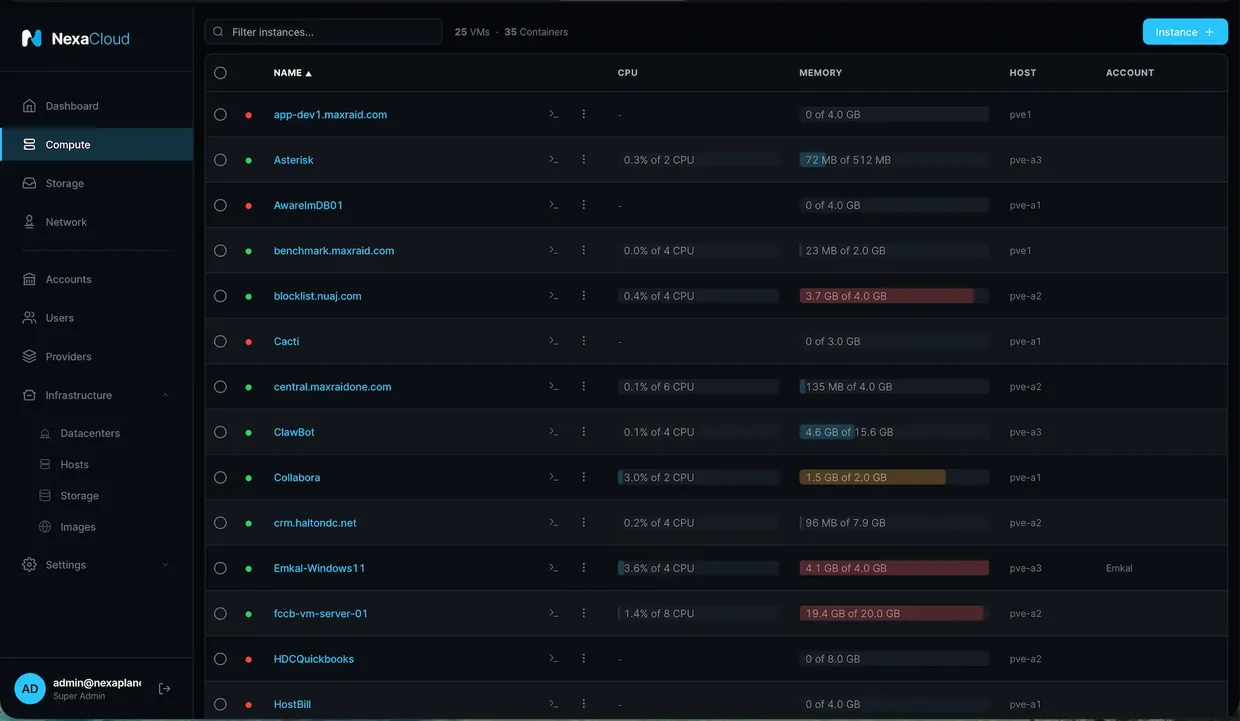
Instances in one step
Cloud images boot in seconds with SSH keys and network configuration already injected. Windows guests get UEFI and a TPM at create, so Windows 11 and Server sell as readily as Linux. Console, media, snapshots, resize and migrate — all from the same screen.
Migrate anywhere, copy anything
Move a running VM to another node, another cluster or another datacenter — live, with real-time progress and bandwidth control. Copy an instance to create a clone wherever you need it. Same-cluster, cross-cluster and cross-datacenter, all from one dialog.
Sell past your own language
The console speaks 16 languages and each person picks their own, so one platform serves every market you sell into. See how languages work
One console for the whole fleet
Cluster health, capacity and every customer action in one place — plus a read-only mode that lets Nexaplane keep monitoring a datacenter while it makes no changes to it, for the nights you are working on the fabric yourself.
Toggle the pair on. Routes on both sides update themselves — and keep updating when the subnets change.
Multi-datacenter
One tenant.
Many sites.
Customers who grow past one location are the ones worth keeping. Nexaplane makes the second site a toggle rather than a project — no manual routing tables, no tunnel to hand-configure, no ticket.
Backup & recovery
Backups you can prove.
Not just take.
Every provider sells backups. Almost none can tell a customer, on the morning it matters, that the backup will actually start. Nexaplane restores a real backup into a sealed network, boots it, waits for the operating system to answer, and then destroys the copy — so "protected" becomes something you can show a customer, not something you both hope.
- Recoverable, as a number — the dashboard says how many workloads could be brought back right now, and names the reason for every one that could not.
- Rehearsals on a schedule — set the cadence in a policy and the platform runs the drill itself, reporting the date it booted and how long it took to come up.
- Sealed by construction — the rehearsal copy starts in an isolated network with no route to anything real, and is destroyed when the drill ends.
- Offsite DR you can sell — grant a second-datacenter copy per account and price it as a tier, instead of absorbing it for everyone.
- Checked, not just written — schedules, retention and integrity checks are policy-driven and applied fleet-wide, and the console shows which copies were verified and when.
- Customers recover themselves — a restore that never reaches your queue, with a plain warning before anything overwrites a machine that is still running.
Nothing in the rehearsal can reach production, and nothing survives it. What survives is the evidence — this workload came back, on this date, in this many seconds.
Each customer is a tenant under you — their own users, quotas and invoice, and never a glimpse of the fabric or of one another.
The provider account
Every platform is multi-tenant.
Few hand you the business.
Carving customers into separate tenancies is table stakes. The provider account goes further — a whole cloud you run under your own name and sell to customers, or run privately for your own departments. You set each account's quotas, meter its usage and issue its invoice; the fabric and every other tenant stay out of view.
- Your brand, your portal — customers sign in to a self-service console that carries your name, not ours.
- Your invoice, your margin — meter and bill each customer directly, and resell add-ons like NuajProtect at the price you set.
- Quotas per customer — hard caps on instances, storage, addresses and GPUs, plus which datacenters each may build in.
- Isolated all the way down — one provider never sees another, and no customer ever sees the fabric beneath them.
- Roles on both sides — admin, operator and user tiers in every account, so your team and theirs get exactly the reach they need.
White-label
Your name on the console.
Not ours.
The console your customers sign into carries your logo, your product name, your colours and the address their support requests go to. Nothing on the page points back to us — because the cloud they are buying is yours, and the software behind it is your business, not theirs.
- Yours end to end — logo, product name, accent colour, browser tab and support address, on every page of the console.
- Their own sign-in page — give a reseller a link and their customers sign in under that reseller's logo and colours, before they have an account with you at all.
- Mail that says who sent it — invitations and verification codes arrive from the reseller's name, not yours and not ours.
- Resellers brand it again — providers selling under you apply their own identity on top, and you decide which of them may. Withdraw it and their branding stops without being deleted.
- In their language too — your brand, and each of their customers reading it in one of 16 languages they choose themselves.
- Changed in the console — set it, see it. No config files, no redeploy, no ticket to us.
Set once at the top and it flows down. A reseller that changes only its logo keeps your colours and your support address — so nothing is left half-branded.
You meter once. Each reseller is billed for everything its accounts ran; its customers are billed by it, on a document carrying its name and its tax registration — never yours.
Reseller billing
Wholesale to your resellers.
Retail to their customers.
An MSP reselling your cloud is not a discount code. It is its own business — its own prices, its own invoice numbering, its own legal identity on the document, and customers who never learn you exist. You meter everything once, bill the reseller at wholesale, and it bills its customers at whatever it decided to charge.
- Two prices on every line — what the reseller pays you and what its customer pays, so the margin is the difference on identical quantities, with no spreadsheet in between.
- One invoice per reseller — every account it runs, itemised for the period, while each of its customers receives a separate invoice from the reseller.
- Their name on the document — legal entity, address, tax registration and logo belong to the reseller. Nothing of yours appears on a bill they collect.
- Metered, never estimated — compute, storage, addresses, transfer and GPUs sampled hourly and priced at the rate that applied that month, so an invoice re-printed a year later still matches the one you sent.
- Tax that matches the seller — each reseller's own rates on its own invoices, on a print-ready document its customer can file.
Coming next — resellers collecting through their own Stripe or PayPal account, so payment moves between them and their customer and never through you.
16 languages
Sell into markets
you don't speak.
Your engineer works in English while a customer in São Paulo works in Portuguese and another reads right-to-left in Arabic — same platform, same afternoon. There is no separate build per market, no translation project of your own, and no language you have to hire for before you can quote.
- Chosen per person, not per install — language is a user's own setting, so one platform serves every market you sell into at the same time.
- Right-to-left done properly — Arabic lays out correctly, rather than being poured into a page built left to right.
- The product, not just the menus — the console, the administrator guide, the customer guide, the release notes and the email itself: the invitation that reaches a new customer arrives in their language before they even have an account.
- Your brand, their language — white-label identity and localization apply together, so a reseller's customer reads that reseller's name in their own language.
- Nothing to maintain — translations ship with the platform and are carried by the upgrade, so a new language is never a project of yours.
- Reach without headcount — quote a market before you staff it, instead of staffing it to find out whether it buys.
Nobody is switched into a market language. Each person sets their own, and everyone else keeps theirs.
The no-brainer
Everything your current cloud does.
None of the weight.
You already know what a platform like this costs to keep alive — the specialists, the upgrades that go sideways, the pieces nobody wants to touch. Nexaplane does the same job with far less to run, support and explain. Every line below is something you are paying dearly for somewhere else.
Runs on standard Proxmox
A stock Proxmox VE deployment — nothing forked, patched or special to maintain, and no second stack to license.
Nothing on your hypervisors
It drives Proxmox over the API — upgrade the fabric and the cloud never notices.
Self-service routers, per tenant
Each customer runs their own virtual router — BGP, firewall, and one-click VPN between their datacenters. No Neutron, no NSX.
Load balancers customers manage
L4/L7 with TLS and health checks, run as the tenant's own appliance — not a black box only you can touch.
Customers serve themselves
A branded portal that quietly closes the tickets your team used to open.
Billing is already inside
Metering, invoices, credits and auto-suspend — not a system you bolt on later.
One service to run
A single binary under systemd — the whole control plane deploys and upgrades in minutes.
Hardware becomes products
GPUs, storage tiers and backups become flavours with quotas — priced and sold like any SKU.
Revenue you simply resell
Add-ons like NuajProtect and offsite DR, at your own margin, on infrastructure you already run.
Every site on one screen
Multi-datacenter from the first login — growth is a toggle, not a migration project.
Watch without touching
Read-only mode keeps a datacenter monitored while it changes nothing — for the nights you are on the fabric yourself.
Priced per fleet
Not per customer, not per core — your margin grows as you fill the racks.
Better together
Sell cloud that
defends itself.
Every Nexaplane tenant already has their own router sitting inline on their traffic. That is exactly where threat filtering belongs — so NuajProtect turns it into a filtered edge, and protected cloud becomes something you can sell rather than something your customer has to source, integrate and manage elsewhere.
NuajProtect is a separate product with its own subscription, licensed per protected edge. It is not bundled with a Nexaplane licence — it is an add-on you resell at your own margin, on infrastructure you already run.
NuajProtect
Filtering where the traffic already is
- At the tenant edge — the router Nexaplane already gives every customer becomes their filtering point. Nothing new in the path, nothing for them to install.
- On the instances — a single static binary under systemd protects an exposed server directly, picking the fastest enforcement the kernel offers.
- At the fabric edge — NuajBridge sits inline with no address on the network it protects, so there is nothing to scan or log into. If anything goes wrong, traffic keeps flowing.
- One threat picture — global intelligence updates both platforms, and what one network learns, the rest benefit from.
- The same operating conventions — MFA, role-based permissions and real-time alerts, so your team learns one way of working rather than two.
The commercial case
A product you can sell
to customers you already have.
Security is the easiest upsell in hosting — and the hardest one to deliver, because it usually means new hardware in the path and a project to go with it. Here it attaches to infrastructure your tenant is already renting from you.
Margin, not a referral
You licence it and you sell it. The relationship, the invoice and the margin stay yours — this is a product in your catalogue, not a handoff to another vendor.
Nothing to roll out
It attaches to the router each tenant already has. No appliance to ship, no maintenance window, no change to their network — which is what usually kills a security upsell.
Sell it as a tier
Standard and protected, priced differently — one decision at checkout instead of a separate security conversation months later.
Edge security
NuajProtect
Plug-in network threat protection for Linux servers, MikroTik routers and whole networks — filtered inline, at line rate, in the kernel's earliest packet path. Sold separately, on its own subscription.
Explore NuajProtectCloud orchestration
Nexaplane
Proxmox turned into a multi-tenant cloud with per-tenant routing, billing and self-service. Two platforms, one operating base, one engineering team.
Request a demoFrictionless architecture.
Run Nexaplane outside your fleet or inside your management cluster. It talks to Proxmox over the API — nothing to install on your hypervisors, nothing to break when you upgrade them.
Developer first
Everything the UI does,
the API does.
The complexity of CloudStack and OpenStack is what made us build this. Both can run a cloud; both ask you to staff a team to keep them running. We wanted the capability without the operations bill.
So there is no second-class API. Provisioning fleets, changing network rules, wiring billing into your CRM — the same documented REST endpoints the console itself calls.
curl -X POST https://cloud.yourcompany.com/api/v1/instances \
  -H "Authorization: Bearer np_live_9a8b..." \
  -H "Content-Type: application/json" \
  -d '{
    "name": "web-node-01",
    "plan": "np-compute-4",
    "image": "ubuntu-24.04-lts",
    "region": "ca-central-1",
    "network": "tenant-prod",
    "billing": {
      "type": "hourly"
    }
  }'
Cost of operation
The download was free.
Running it never was.
CloudStack, OpenNebula and OpenStack cost nothing to install and a fortune to operate — the bill arrives as specialists on staff, upgrades that eat weekends, and architecture you fight instead of use. Nexaplane delivers the same capabilities on standard Proxmox, run by a fraction of the people it takes to keep them alive.
The architecture fights you
- A management server, database and system VMs that only you can un-break
- Advanced-zone networking that punishes every change
- Years of workarounds you finally get to retire
Lighter, still a second system
- Sunstone plus a drawer of drivers to keep current
- Networking and billing bolted on, not built in
- Runs on standard Proxmox — no host layer to curate
A team just to stay online
- A dozen services — Nova, Neutron, Cinder, Keystone, Glance — each its own upgrade
- Dependency and downtime pain on every release
- Headcount whose whole job is keeping it up
More than twenty years running data centers taught me what CloudStack and OpenStack really cost: nonsensical complexity, and quality you can never count on. Eventually I'd had enough. So I built the opposite — simplicity, elegance and function, aimed at the only job that matters: running a cloud business.
Antoine Boucher · Founder of Nuaj, owner of Halton Data Center
The move, not the migration
You don't rip anything out first
Point Nexaplane at the Proxmox you already run — it runs as a single lightweight container, with no agents baked into your hypervisors. Import running guests, stand tenants up beside the old platform, and cut each over when it is ready. The heavy stack — and the operations bill it carries — switches off last.
Why Nexaplane
The simplicity matrix
The same job, measured against the platforms you are probably weighing us against.
| Capability | Nexaplane | VMware vCD | CloudStack | OpenStack | OpenNebula | Proxmox VE (raw) |
|---|---|---|---|---|---|---|
| Time to a working platform | Minutes | Weeks | Weeks | Months | Days | Hours |
| Per-tenant router (BGP, VPN, firewall) | Automatic | NSX (costly) | Manual zones | Neutron (complex) | Manual drivers | Manual setup |
| Self-service load balancer (L4/L7, TLS) | Native | NSX ALB (costly) | Basic | Octavia (complex) | Manual | None |
| Cross-datacenter interconnect | One click | Manual | Manual | Custom dev | Manual | None |
| Sellable storage tiers | Native | Manual | Manual | Manual | Manual | None |
| Cross-cluster & cross-datacenter migration | Live, one dialog | vMotion (live, $$$) | Manual | Manual | Manual | Same cluster only |
| Self-service backup & DR | Built-in | Third-party | Limited | Third-party | Add-on | Admin only |
| GPU as a sellable product | Native catalog | Manual | Manual | Manual | Manual | Manual |
| Built-in billing (Stripe/PayPal) | Native | Third-party ($$) | Third-party plugins | Custom dev required | Showback only | None |
| Customer self-service portal | Modern UI | Clunky UI | Dated UI | Horizon UI | Sunstone UI | Admin only |
| Integrated edge threat protection | First-party add-on | Third-party | Third-party | Third-party | Third-party | None |
| Agents on your hypervisors | None | Required | Required | Required | Required | N/A |
| Infrastructure overhead | Ultra-light | Heavy | Medium | Massive | Medium | Light |
Transparent pricing
Priced per fleet,
not per customer.
Licence the platform once. Add as many tenants as you can sell — we never take a cut of your revenue.
Up to 3 nodes on your own cluster. No card. Whatever you do next, the platform you built during the trial carries straight over — buy a licence, or drop to the free Community tier and keep running. Same install, same configuration, no rebuild.
- Up to 2 hypervisors
- Unlimited tenants
- Paying customers allowed
- The full platform, nothing disabled
- Up to 10 hypervisors
- Unlimited tenants
- Community support
- Stripe billing
- Up to 20 hypervisors
- Custom branding (white-label)
- Advanced networking features
- Priority support
- Up to 100 hypervisors
- High-availability setup
- Custom API integrations
- 24/7 SLA support
- Unlimited hypervisors
- Source code licence option
- Dedicated account manager
- On-prem deployment assistance
The Community tier is the same build paying licensees run, and it never expires. The 14% annual maintenance fee applies to the paid tiers and covers software updates and priority support. NuajProtect is licensed separately and is not included in a Nexaplane licence.
Questions
What operators ask
before the first
call.
Can Proxmox be made multi-tenant?
Does Nexaplane install anything on my Proxmox hosts?
How do I bill customers for Proxmox virtual machines?
How do resellers bill their own customers?
Can I sell VPS hosting on Proxmox with Nexaplane?
Is Nexaplane a control panel for Proxmox?
How can I prove a backup will actually restore?
Is there a free version of Nexaplane?
Can I white-label a Proxmox cloud portal?
What languages does the Nexaplane console support?
How do I give clients a self-service portal for their own VMs?
Do I have to move my existing VMs to start?
See it on your own fabric.
Bring a Proxmox cluster and we will show you a tenant, a network, a router and a running instance — in the same call.
Launching 2027 · Early partners get direct input on the roadmap